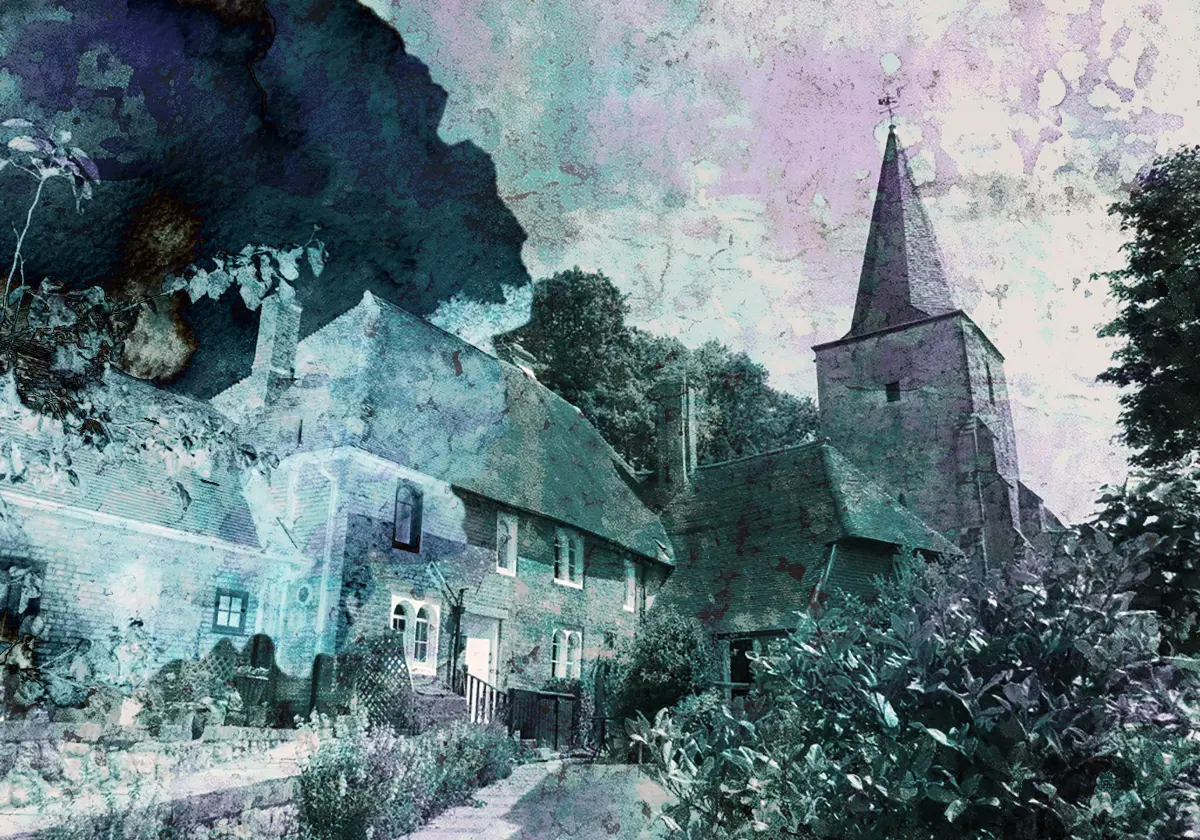

Pluckley Village: Exploring the Truth Behind England’s ‘Most Haunted Village’
Introduction
Pluckley, a small rural parish in the Ashford district of Kent, has carried for more than three decades the popular label of England’s “most haunted village”. The phrase entered widespread circulation after the 1989 edition of the Guinness Book of Records mentioned Pluckley under such a heading, citing the unusually high number of alleged ghosts said to appear in and around the village lanes, the churchyard of St Nicholas, neighbouring Dering Woods and several historic houses. Since then travel features, television crews and paranormal enthusiasts have regularly descended on the village, amplifying its reputation and producing a layered body of folklore that now coexists with sparse historical documentation.
This article examines what can actually be substantiated. It traces the origins of the principal ghost stories, considers the social and landscape context that allowed them to spread, and evaluates later investigations and media portrayals. It weighs believer testimony against documented records, natural explanations and methodological criticism from historians and sceptical commentators. Rather than repeat embellished lists of a dozen or more apparitions, it seeks to place each frequently cited figure in chronological and evidential order. By the end a clearer picture emerges: Pluckley represents a vivid case study in how a modern English haunting legend develops through interweaving strands of genuine local tradition, misremembered events, repetitive retellings and commercial tourism agendas.
Historical Background
Pluckley sits near the edge of the Greensand Ridge roughly eight miles west of Ashford. The parish appears in Domesday Book as “Pluchelei” and remained a modest agricultural settlement for centuries. The locally influential Dering family became associated with a nearby estate and left architectural marks such as distinctive pointed windows known colloquially as “Dering windows” in certain properties. Agricultural change, enclosure and mild population fluctuations across the nineteenth century formed the normal rural pattern; the village did not experience the heavy industrialisation seen elsewhere, preserving a quiet landscape with lanes bordered by hedgerows and woodland pockets. These characteristics, especially evening mist in lower fields and the dark stands of trees at the edge of Dering Woods, provide environmental conditions often cited in rural ghost lore: limited artificial light, complex sound reflections and shifting visual contrasts.
The emergence of Pluckley’s catalogue of ghosts is not easily pinned to a single outbreak period. Some stories claim roots in eighteenth or early nineteenth century tragedies: a highwayman allegedly pinned to a tree by soldiers, a schoolmaster who hanged himself, a watercress woman who burned to death when her pipe set fire to straw, and a miller said to have died in a blaze. Yet systematic early references are scarce. Local directories and nineteenth century Kent newspapers more frequently recorded agricultural matters, petty crime and parish notices than spectral incidents. Where haunt narratives did exist they circulated orally or in ephemeral print now lost. The consolidation appears to have accelerated during the twentieth century, especially mid century when ghost story anthologies and later television interest in “spooky England” segments looked for picturesque rural backdrops.
The Guinness Book of Records inclusion in 1989 acted as a pivotal publicity moment. While the record category has since lapsed (Guinness no longer lists a “most haunted village”), the short mention crystallised a marketing phrase that newspapers, coach tour companies and paranormal groups repeated. The number of alleged ghosts cited has varied from about twelve to sixteen depending on the source, indicating a fluid tradition rather than a fixed documented register. This fluidity is crucial to evaluating authenticity. A stable set of historically anchored reports would suggest a core of persistent phenomena; instead Pluckley’s roster has shifted as storytellers elevate or drop particular figures.
The Events
The “events” in Pluckley are better conceived as a patchwork of recurring anecdotal motifs centred on locations. Rather than a single outbreak like a poltergeist siege, Pluckley features place linked legends. Each of the most cited is summarised with the principal claimed manifestations and any available traceable documentation or subsequent enquiry.
1. The Red Lady and The White Lady (St Nicholas Church)
Many popular lists name two female apparitions associated with the churchyard: a “Red Lady” wandering searching for an infant, and a “White Lady” purportedly entombed in seven lead coffins inside an oak sarcophagus. The imagery of layered coffins appears in Victorian antiquarian fascination with elaborate burials, yet parish burial registers contain no explicit extraordinary notation identifying a sealed multi coffin burial matching the legend. Accounts printed in late twentieth century ghost compendia summarise local volunteer guides rather than first hand sworn statements describing a visual apparition with date and witness identity. Claims of a gentle luminous form by headstones have typical features of cemetery ghost reports: diffuse light, quiet movement, absence of speech. Alternative explanations include misidentification of mourners with lanterns or reflected vehicle lights introduced as traffic flow increased along nearby routes in the twentieth century.
2. The Highwayman at Fright Corner
Fright Corner, a roadside location whose name conveniently lends itself to ghost marketing, is said to host a highwayman spectre pinned to a tree by a soldier’s sword or multiple blades. Efforts to locate nineteenth century inquests or criminal reports describing such a dramatic execution style death in the immediate vicinity have not produced corroboration. Highway robbery certainly occurred historically across Kent roads, yet the tree pinning method resembles folkloric dramatic flourish. Visual sightings usually describe a dark figure darting across the lane or emerging near a hedge before fading. Passing vehicle headlights, partial silhouettes of modern pedestrians or deer movement are candidate natural stimuli. The absence of consistent date stamped witness logs limits evidential weight.
3. The Screaming Man (Former Brickworks or Sand Pit)
One narrative concerns a labourer supposedly suffocated or crushed at a former brickworking or clay pit site, his cries still heard. Industrial accidents did occur historically in extraction pits, but specific documented correlation to Pluckley’s recurring sound reports is thin. Modern visitors occasionally report wind induced whistling or fox shrieks, well known in rural acoustic misidentification cases. Without primary accident reports specifying the individual’s name and date, the story remains a thematic grafting of generic tragic labour death motifs onto a real industrial landscape element.
4. The Watercress Woman (Bridge or Stream Side)
This apparition involves an elderly woman said to have sold watercress who fell asleep with a pipe, ignited her bundle of straw and burned, later appearing as a faint figure or a small flickering light. Newspaper searches for a fatality matching the description have not yielded a verified contemporary notice. The motif of a vendor perishing by stray spark appears in multiple English county ghost catalogues, suggesting narrative portability. Flickering lights at low lying damp ground can arise from vehicle light scatter or brief combustion of methane pockets, though will o’ the wisp style explanations are often invoked without measurement.
5. The Schoolmaster
Stories tell of a depressed schoolmaster who hanged himself and now appears by a lane or in a schoolroom ruin. Verifiable school records listing a teacher suicide locally are not widely reproduced in credible historical compilations. Self harm cases were sometimes discreetly recorded due to social stigma, yet the lack of an identifiable name hampers evaluation. Apparition description is generic: a quiet male figure in period attire. Many such reports surface only after reading earlier ghost lists, introducing expectancy bias.
6. The Miller (Former Mill Site)
An apparition of a miller allegedly appears wreathed in smoke or sparks after a mill fire. Fire at mills was historically common, yet tying a surviving apparition claim to a documented Pluckley mill conflagration requires cross referencing property insurance or local press. Available popular sources recycle the same brief line without citation. Where no contemporaneous mill fire report is cited the account remains a motif.
7. The Coach and Horses (Village Lanes)
Some witnesses have reported the sound of horses and wheels on a lane with no visible source, occasionally followed by a faint outline of a coach. Residual style haunting language is commonly applied: a non interactive recurrent auditory phenomenon. Acoustic carry of distant equestrian traffic or modern vehicle tyre patterns on uneven surface could produce impressions of older conveyance. Instrumental audio monitoring studies specifically targeted at establishing repetition patterns do not appear in published form for Pluckley.
8. The Monk or Clergyman
Another frequently listed figure is a quiet monk or cleric seen near former monastic land or at the churchyard edge. Pluckley does not host a standing medieval monastic ruin of the scale that typically anchors such sightings. The appearance of robed hikers or mistaken identification of long coats under low light can seed such traditions. Again no early dated affidavit style testimony is readily publicly available.
9. The Little Dog
Pet or animal apparitions are occasionally claimed. A small dog darting into a hedgerow and vanishing is cited in at least one late twentieth century magazine feature. Animal misperception in twilight, especially with partial illumination, can produce vanish illusions when an animal changes direction behind vegetation. Without repeated controlled observation this claim carries little evidential strength.
10. Dering Woods (Sometimes Styled “Screaming Wood”)
Adjacent Dering Woods have accrued a micro folklore of disembodied screams, mist shapes and feelings of dread. Mists are common given local humidity and temperature gradients. Auditory reports correlate with animal calls (particularly foxes) whose high pitched vocalisations can sound disturbingly human to those unfamiliar. The label “Screaming Wood” appears to have been emphasised in paranormal enthusiast literature after broader publicity rather than originating from long standing parish usage.
Patterns Across Reports
When collated, Pluckley’s phenomena share features: low daylight illumination, witness priming by prior knowledge of local legends, absence of multi witness convergent detailed description, and a reliance on retellings rather than preserved primary documents. There is no poltergeist class physical interaction of the sort documented in some twentieth century English cases. Nor are there extensive photographic or audio records subjected to independent analysis whose chain of custody can be traced. The events category thus comprises a folkloric catalogue rather than a structured evidential haunting file.
Investigation and Evidence
Paranormal investigations in Pluckley have ranged from informal night vigils by local enthusiasts to televised teams producing entertainment oriented programming. Key elements often cited as “evidence” include anecdotal witness interviews, environmental control meter readings, photographs with orbs or light anomalies, and subjective impressions captured during electronic voice phenomena (EVP) sessions. Each category demands examination by evidential standards.
Early Documentation and Writers
One of the principal compilers of English ghost lore, Peter Underwood, referenced Kent hauntings broadly and contributed to the codification of Pluckley’s list during late twentieth century writing. Underwood and other authors gathered stories from local sources, but the methodology generally involved collecting anecdote rather than applying experimental controls. Nevertheless, these works serve as partial time markers showing what stories had crystallised by particular publication dates. They help demonstrate that the list had achieved a shape by the 1970s to 1980s, prior to the Guinness reference publicising it nationally.
Guinness Book of Records Mention
The 1989 Guinness mention did not constitute an investigative report in scientific terms. It repeated the claim of the highest number of alleged ghosts in a village scale location. Important to clarity, subsequent Guinness policy changes removed subjective superlatives related to haunted status due to difficulty verifying such claims. Thus the book’s inclusion operates historically as a publicity catalyst not as verification.
Television and Media Investigations
Television programmes focusing on haunted Britain have filmed in Pluckley. Production teams typically follow a narrative arc: daytime history introduction, night time investigation sequences, participant reactions, then interpretive commentary. Instrumentation often includes EMF meters, temperature sensors and night vision cameras. Peer reviewed parapsychological literature cautions that field EMF fluctuations can derive from mundane electrical infrastructure. Published data sets isolating anomalous spikes at Pluckley inconsistent with known sources are not broadly accessible. Video recorded personal reactions without external corroboration remain testimonial rather than independent evidence.
Photographic and Audio Material
Commonly circulated photographs from Pluckley show either faint lights, ambiguous mist shapes or orb artifacts. Orbs are widely understood to arise from out of focus dust or moisture particles illuminated by flash. Mist gestures can form from breath ahead of camera on cold nights. Audio clips labelled EVP usually contain brief ambiguous syllables within background noise. Without control recordings matched for environmental conditions and blind evaluation, such clips cannot be rated above coincidental pareidolia. No high standard controlled experiment results from Pluckley have been published in mainstream parapsychology journals with replication attempts.
Local Testimony
Interviews with residents occasionally produce cautious statements: some long term villagers describe a reputation that attracts outsiders more than frequent personal experiences. Others note sporadic odd lights or sounds without claiming definite apparitions. The diversity of testimony, including sceptical resident voices, undercuts simplified narratives of a universally haunted environment. Where interviews lack full names, dates and precise times they function as folklore transmission rather than strict evidence.
Analysis and Perspectives
Believer Perspective
Supporters argue that the sheer quantity of distinct apparition traditions focused on a small geographic area indicates an underlying paranormal substrate. They emphasise multi generational oral continuity, claiming that independent lines of story (e.g. highwayman, Red Lady, coach) coalesced organically. They also point to subjective personal experiences of chill, dread or sensed presence during vigils as aligning with purported spirit activity. For believers, Pluckley demonstrates a classic “psychic imprint” or residual recording environment with occasional intelligent manifestations responding to attention.
Folklore and Sociocultural Dynamics
Folklorists would characterise Pluckley as a living legend ecology. The village’s stable rural architecture, evocative woodland boundary and relative ease of access from London make it a prime stage for contemporary legend rehearsal. The Guinness mention offered an authoritative sounding anchor around which newspapers could build seasonal Halloween features. Each new article often listed the ghosts, sometimes adding creative embellishment for narrative colour. This process created an expectation cycle: visitors arrived primed to encounter something, then ambiguous sensory inputs were interpreted through ghost categories and reported back online or to authors, reinforcing the reputation. The iterative cycle explains why the count of ghosts remains flexible; the system rewards addition of variants.
Psychological and Perceptual Considerations
Sceptically oriented analysts highlight cognitive biases. Expectancy and confirmation bias increase the chance of interpreting ambiguous stimuli as paranormal in a location branded “most haunted”. In low light, peripheral vision monitoring of movement is unreliable. Auditory misperception of animal calls (foxes, owls), distant traffic and wind through foliage can yield apparently uncanny sounds. Memory conformity within groups can homogenise an originally diverse set of impressions into a shared story that later appears more detailed than initial raw perceptions.
Environmental Explanations
Potential naturalistic factors include: microclimate mists forming temperature inversions over fields near hedgerows, reflecting modern light sources; acoustical ducting carrying distant sounds anomalously; vegetative motion patterns in patchy light creating fleeting human shaped illusions; and mundane EMF variations from underground or overhead utility lines triggering meter responses exploited in entertainment settings. These explanations do not disprove the possibility of anomalous phenomena, but they offer sufficiency for many reported features without invoking discarnate agencies.
Evidential Assessment
Applying evidential criteria emphasised in serious psychical research (clear multi witness observation with independent descriptions, direct physical effects recorded under control, chain of custody for media, archival documentation of origin events) Pluckley presently falls short. The case stands as a cultural phenomenon in ghost lore generation rather than a robust investigative case. That does not diminish community identity aspects or visitor curiosity value. It reframes the tagline from a statement of verified haunting density to a marker of folklore productivity.
Unresolved Questions
Several research avenues remain open: a systematic archival trawl of Kent newspapers for any cluster of nineteenth century accident or death reports aligning with motifs; a structured mapping of reported sighting coordinates with environmental conditions to test for patterning; and oral history captures from older residents to date the internal circulation of specific ghost stories prior to media amplification. Undertaking these steps could either strengthen the historical backbone of a subset of legends or clarify their modern emergence timeline.
Cultural Impact and Legacy
The cultural footprint of the Pluckley haunting claim has been substantial relative to the village’s small population. Television crews, paranormal tour organisers and journalists have produced economic ripple effects via hospitality use and visitor spend. Seasonal features in national newspapers reprise the list, often leaning on atmospheric photography of the churchyard or woods. The “most haunted” label became semi detached from its Guinness origin and now functions as a stand alone marketing phrase, sometimes without context that the record category is retired.
Locally, reactions are mixed. Some residents embrace controlled heritage tourism. Others express fatigue at late night visitors trespassing or causing disturbance. This tension mirrors other English sites where myth reputations generate footfall beyond infrastructure capacity. Online forums frequently reference Pluckley in discussions of British haunted travel itineraries, cementing it as an accessible introduction point for casual paranormal interest. The legend also feeds broader cultural narratives about the English countryside harbouring layers of tragic memory beneath tranquil surfaces.
In literary and media contexts Pluckley is cited in ghost tour scripts, magazine listicles and anthology chapters. While it has not spawned a singular blockbuster film adaptation, its aggregate presence across formats grants it endurance. The flexibility of its ghost roster allows adaptation to different audience tastes: romantic sorrow (Red Lady), violent crime (highwayman), domestic tragedy (watercress woman) and atmospheric soundscapes (screaming woods). This narrative adaptability helps maintain cultural relevance even as sceptical voices challenge factual grounding.
Current Status
In the present decade Pluckley continues to appear on paranormal travel lists, yet investigative focus among serious researchers has shifted toward cases with richer primary documentation. Guinness no longer recognises a “most haunted village” entry, a fact now noted by many responsible articles to temper sensationalism. Contemporary systematic sightings logs are sparse; most new online claims recycle earlier motifs without novel evidential detail. The location remains accessible: St Nicholas Churchyard is a place of worship and must be treated respectfully; Dering Woods are walkable public woodland with standard countryside safety considerations. Visitors increasingly encounter signage or local guidance discouraging disruptive night time activity. The legend persists as a living cultural artefact, offering a window into how modern haunting reputations form rather than a catalogue of substantiated paranormal events.
References and Source Notes
Because many ghost story compilations recycle narratives without citation, careful differentiation is required between primary and derivative sources. The following categories summarise the evidential landscape relevant to Pluckley:
- Guinness Book of Records (1989 edition) brief mention establishing popular phrase; category later discontinued.
- Works by English ghost lore compilers (e.g. Peter Underwood) providing mid to late twentieth century consolidation of oral stories. These are secondary compilations, not controlled investigations.
- Local Kent newspaper features (late twentieth and early twenty first century) repeating and occasionally elaborating ghost lists, primarily around Halloween tourism cycles.
- Television paranormal entertainment programmes producing episodic investigations with limited methodological transparency; evidence presented should be regarded as anecdotal dramatisation.
- Folklore and sceptical commentary in newspapers and online articles pointing out absence of documentary backing for specific claimed deaths (e.g. highwayman tree skewering, watercress woman burning) in accessible archival records.
Further research would benefit from digitised nineteenth century Kent press corpus searches for relevant accidents or inquests and structured environmental logging during claimed peak activity times. Until such data sets are published the Pluckley record stands more as a cultural legend cluster than a validated multi apparition case file.
This article follows the site’s famous hauntings content guidelines, emphasising factual balance, British English spelling and clear distinction between folklore narrative and documented evidence.